Enabling agroecological transformation at scale through landscapes.
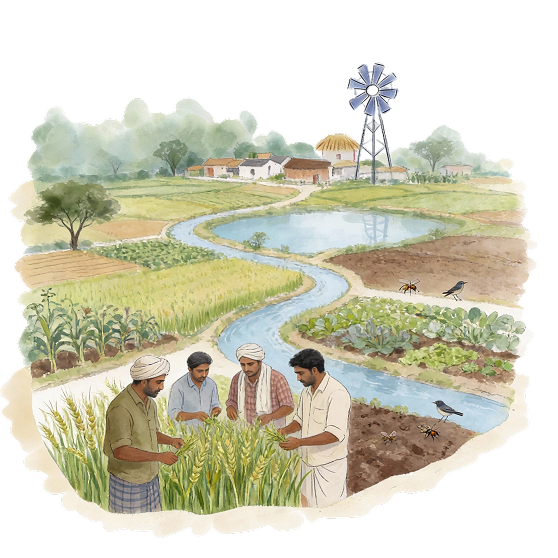
CAT’s strategy is centred on demonstrating that a holistic, place-based, and systems-oriented agroecological approach at the landscape level – the minimum viable unit for lasting transformation – is the most critical missing link in India’s current agricultural transition efforts.
Rather than promoting isolated practices or projects, CAT focuses on enabling coordinated change across entire landscapes, addressing ecological, social, institutional, and financial dimensions together. This approach recognises that agroecology can only be sustained at scale when farmers, institutions, markets, and finance move in alignment within a defined geography.
What is a landscape? A landscape here typically corresponding to an area of approximately 50,000 hectares, or 100,000 people, or an administrative unit such as a block (or its subsection) in India. This scale allows for the aggregation and emergence of viable local economies, effective governance, and sustained provisioning of services to communities.
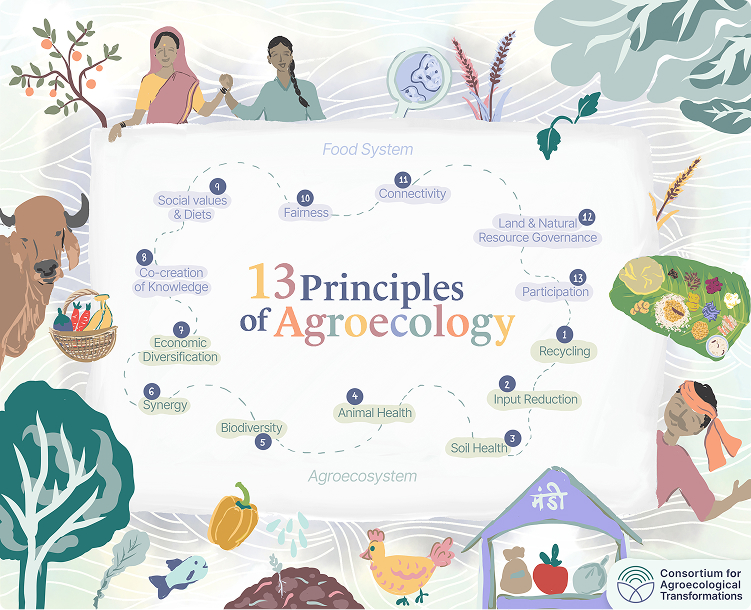
CAT’s landscape-level planning explicitly accounts for actions that amplify and integrate the 13 agroecological principles, ensuring that agroecology is advanced not as a checklist of practices, but as a coherent and context-sensitive system.
The Landscape Framework
Coordinating action across interconnected systems.
CAT’s landscape approach is anchored in a systems framework that identifies the key elements required for agroecological transformation. Transformation depends not on individual interventions, but on how these elements interact and reinforce one another over time.
Change emerges through coordinated action within landscapes — across farming systems, institutions, and livelihoods—and across landscapes, through shared learning and the diffusion of knowledge across diverse contexts. This requires multiple stakeholders to align their efforts across interconnected parts of the system.
Goals of Transformation
What CAT seeks to enable through
landscape-scale agroecology.
Through its integrated, landscape-based approach, CAT seeks to enable agroecological transformations that:
Improve the quality of natural resources, including soil, water, flora and fauna.
Increase farm incomes and make agriculture a viable and attractive livelihood, particularly for youth
Improve the well-being of smallholder farmers, women, and landless agricultural workers
Improve the quality of natural resources, including soil, water, flora and fauna.
Enhance food and nutrition security at household and community levels
Contribute meaningfully to climate mitigation and adaptation
Our Levers for Change
Supporting community-led adoption through aligned systems.
At the heart of CAT’s approach is the understanding that agroecological change is rooted in society – in farmers, communities, and civil society organisations. For this change to be sustained at scale, it must be supported by enabling systems. CAT therefore works through three mutually reinforcing levers — Policy, Markets, and Finance — to create the conditions under which agroecological practices can be adopted, sustained, and scaled across landscapes.
Reorienting Policy
Creating enabling environments for agroecology.
CAT engages with state and national governments to demonstrate how existing policies, programmes, and institutional mechanisms that incentivise agroecological transitions can be integrated into mainstream agricultural planning. This includes scaling proven models developed by civil society organisations, aligning with and strengthening initiatives such as the National Mission on Natural Farming, and exploring the creation of Special Agroecological Zones (SAZs), where policies and programmes are intentionally aligned to create a level playing field for agroecology
CAT’s approach focuses on demonstrating practical pathways for convergence, including through mechanisms such as the Minimum Support Price (MSP), Public Distribution System (PDS), Mid-Day Meal schemes, MGNREGA, and subsidies for fertilisers and energy, so that public resources support long-term agroecological outcomes. CAT’s Policy Task Force anchors this work.
Building Markets
Strengthening value realisation and demand.
CAT recognises that strengthening markets for chemical-free, agroecological food is essential for improving livelihood resilience and sustaining farmer transitions. Market-related work therefore focuses on strengthening local and regional market systems, supporting aggregation and value realisation, and building consumer trust and confidence in agroecological produce.
By reinforcing demand-side incentives and improving linkages between producers and markets, CAT seeks to shift market dynamics in favour of agroecological producers and enable better and more stable value realisation. CAT’s Market Task Force leads this effort.
Mobilising Transformation Finance
Aligning capital with long-term transitions.
To support sustained agroecological transformation, CAT mobilises catalytic and blended finance to de-risk adoption and enable long-term, landscape-level transitions. This includes designing financing architectures suited to community-led transformation, aligning public, philanthropic, and private capital pathways, and supporting innovation where conventional finance falls short.
By addressing risk and time-horizon constraints faced by farming communities, CAT seeks to ensure that finance acts as an enabler of agroecology rather than a constraint. This work is led by CAT’s Finance Task Force.
Our Landscapes
Working across landscapes with deep, on-ground partnerships.
Why these landscapes
CAT’s work is anchored in landscapes where agroecological transitions are already taking root. These are geographies with deeply embedded civil society partners, visible histories of agroecology-oriented practice, and strong community motivation to strengthen and scale this work. Across these landscapes, there is also a growing willingness within government systems to support agroecological approaches through programmes and convergence. Together, these conditions provide a strong foundation for coordinated, landscape-level action, while the diversity of contexts ensures learning and adaptation remain central to the work.
Where CAT is working
CAT is currently focused on 11 landscapes in 11 states, working closely with anchor partners embedded in each geography. These landscapes span diverse agroecological, social, and institutional contexts and together form CAT’s platform for coordinated implementation, learning, and system strengthening.
What this enables at scale
Collectively, the current CAT landscapes are expected to:
Directly influence approximately
Hectares
0
Directly influence approximately
people
0 Million
Benefit around
farming households
0
How CAT plans for landscape-level transformation
Within each demonstration landscape, CAT supports the development of a landscape-based investment plan that serves as a shared blueprint for coordinated action.
Ananya oversees programme design and implementation across CAT’s priority landscapes. She works closely with partners to align field-level initiatives with CAT’s broader agroecological vision. With experience in sustainable agriculture and community-led development, she focuses on strengthening collaboration, tracking progress, and ensuring learning feeds back into strategy. Ananya plays a key role in translating collective goals into actionable programmes while supporting adaptive, context-sensitive approaches across diverse geographies.